Why a Leg-Side Field Can Change a Batter’s Options
Learn how a leg-side field shapes a batter’s scoring choices, what a bowler is inviting and how to read the likely line of the next ball.
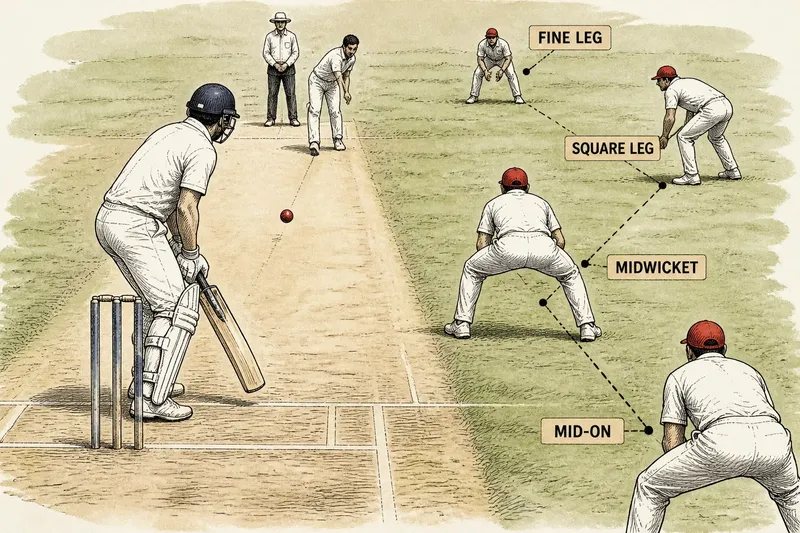
A batter clips a ball towards square leg, but the fielder is already waiting there; the shot brings no run, and the next delivery is aimed at the pads again. To understand a leg-side field in cricket, watch how the fielders narrow or invite particular scoring choices, then look for the bowler’s likely response.
The field is not a prediction of exactly where the ball will go. It is a clue about the contest: which shot the captain is willing to concede, which one the bowler hopes to tempt, and what the batter might change next.
Why does a leg-side field seem to close off easy runs?
Leg-side fielders occupy the side of the pitch behind the batter’s legs as they face the bowler. Common positions include fine leg, square leg, midwicket and mid-on. Their exact placement matters: a fielder close to the bat can stop a glance, while one deeper can patrol the boundary against a pull or a firmly struck clip.
When several fielders guard this side, the obvious leg-side strokes may bring little reward. A ball on the pads looks easy to turn away, but if fine leg and square leg are placed to cover the likely angles, the batter may find only a single—or no run at all.
That does not make the leg side closed. Gaps remain between fielders, and the same fielder cannot cover every depth and angle. Read the positions as a map of the captain’s priorities, not as a wall.
What causes a batter to keep picking out a fielder?
A frequent trap is to judge the field only by its nearest player. A batter may see a gap behind square and try to steer the ball there, yet the ball’s pace, bounce and line can make the intended angle difficult. A small change in the point of contact can send the shot straight to the fielder instead.
Another cause is a predictable response to the same line. If the bowler keeps targeting the body, the batter may repeatedly work across the line towards midwicket. The captain can station a catcher or a boundary fielder in that channel and make the familiar stroke less attractive.
Try tracing the ball’s path from release to contact, then imagine the batter’s bat face at impact. If the shot depends on a late glance, a ball that is straighter or shorter may turn it into a cramped push rather than a clean scoring stroke.
How can the field hint at the bowler’s plan?
Start with the relationship between the field and the line of attack. A crowded leg side can support a plan to bowl at the body, limiting room for a free swing through the off side. A deep square-leg or fine-leg fielder may be there to catch a mis-hit or prevent a boundary if the batter attempts a pull or glance.
But the same arrangement can also invite a particular shot. If the leg side is protected, the bowler may offer a ball that looks easy to work into that coverage, hoping the batter hits towards a waiting fielder. A captain might leave more space on the off side, then use a line that encourages the batter to reach across or manufacture a stroke.
Look for the bowler’s actual execution before settling on an interpretation. A fielder’s position suggests a plan; repeated lines, lengths and changes of pace show whether the bowler is carrying it out.
What if the batter keeps scoring on the off side?
A leg-side-heavy field can leave room elsewhere. If the batter has space to drive or cut through the off side, that may be the price the captain is prepared to accept in order to guard the leg-side boundary. The batter’s success there does not necessarily mean the field has failed; the captain may be asking for a lower-risk shot rather than the batter’s preferred release stroke.
For the viewer, compare the off-side gap with the bowler’s line. A wide ball may let the batter reach out and play freely, while a straighter ball can cramp that option. If the bowler begins to move the line away, the field may be trying to steer the batter into a shot that carries more risk.
For a batter, the useful adjustment is not simply to swing harder into the empty region. It may be better to wait for a ball that allows a balanced stroke, or to use soft hands and take a safe single if the gap is accessible.
What should you try when the field and shot do not match?
Say you are watching a right-handed batter face a bowler with a deep square leg, a fine leg and a close midwicket, while the cover region is open. The batter keeps trying to flick balls from the body through midwicket. If the next ball is again directed at the pads, the field suggests that the captain is content to make that stroke hit into cover; the batter might instead wait for a ball with room to play through the off side, or choose a controlled single into a genuine gap.
Use this order to make sense of a stubborn pattern:
- Locate the fielders. Note who is close and who is protecting the boundary on each side.
- Check the batter’s stance. A right-hander and left-hander face different lines and angles, so the same positions can serve different purposes.
- Watch the ball’s line and length. Separate the intended plan from a delivery that has drifted or missed its target.
- Track the batter’s contact. A cramped defence, a controlled push and a committed pull reveal different options.
- Look for the response. A change in field position or bowling line may show that the batter’s choice has altered the contest.
This sequence keeps one boundary or dot ball from becoming the whole story. The useful clue is how the field, delivery and shot fit together over successive balls.
What questions help read a leg-side field?
Does a packed leg side mean the bowler will bowl at the batter?
It can point towards that plan, especially if the fielders are positioned to cover glances and pulls. Watch the next deliveries before deciding: the bowler may instead use the field to invite a shot towards a protected area.
Why leave a gap on the leg side?
A captain may leave a gap to tempt the batter into a stroke, or because another area needs protection. The bowler’s line and the batter’s preferred shots help explain which possibility is more likely.
Can a batter still score leg-side runs against a crowded field?
Yes. A batter can find a gap, use a soft touch or wait for a delivery that changes the angle. The field makes some choices harder; it does not remove every scoring route.
What does a deep leg-side fielder tell me?
The captain is guarding against a shot that could travel to the boundary from that area. It may also encourage the batter to aim for a safer single, depending on the ball and the open spaces around the fielder.
How should the next ball change your reading?
After a batter plays into a leg-side fielder, see whether the bowler repeats the line, changes the length or moves the ball away. A repeated plan can test whether the batter will keep choosing the same stroke; a change may be an attempt to exploit the adjustment the batter has just made.
Also notice whether the captain moves a fielder after a scoring shot. Shifting a boundary fielder closer can concede a single to guard against a larger hit, while bringing someone into the ring can challenge the batter to clear the field. The reason becomes clearer when you connect the move to the batter’s previous shot.
Reading a leg-side field is therefore a matter of matching positions to possibilities. The next time a fielder waits behind square, use the leg-side field as a clue to the bowler’s likely line, then check whether the batter’s response opens a different route on the next ball.